
Creativity, Spontaneity, and Anxiety
The most important lesson from my clinical internship

There is a direct correlation between creativity and anxiety
Out of everything I learned in my near 1,000 hours of clinical mental health work was this fact: when creativity and spontaneity go up, feelings of anxiety go down.
That’s it. That’s the newsletter. Go and do…
Just kidding. Kinda. When I am feeling anxious about an upcoming performance, meeting, conversation, trip, etc., reconnecting to my creative thinking and spontaneous spirit—through action—helps decrease these unpleasant emotions ª. The more often and more habitually I practice creative work or playing and being spontaneous, the less generally anxious˚ I am.
What should it look like?
Creativity doesn’t have to be drawing or painting or jazz composition—it can be woodworking, gardening, designing, organizing, or even simply enjoying the creativity of someone else through a museum. Use of imagination, inventiveness, and innovation are all creative acts, which have the desired effect. Coming up with a creative solution to a problem, something that stretches beyond your current thinking, can move you from feeling anxious about the future to feeling hopeful or curious about what is possible.
Spontaneity may be harder for a lot of us in the modern west to access. I think about the child-like joy found in climbing big rocks in the woods or building sand castles on the shore, going on a walk or drive with no path or destination in mind, or getting lost in rich conversation with a friend or colleague. You could certainly join an improv class or “let the spirit move you” in any number of ways. Whatever you do, a little bit of spontaneity in your every day will have a positive influence on your mood and relationships.
If anxiety is up, look for where creativity is down
Understanding this simple relationship can transform the way we experience anxious feelings and moments. It can be both preventative and responsive. A quick doodle in a stressful meeting might be the little hit to anxiety that drives it down.
You are the expert on you, so figure out ways you are comfortable being creative right now, and do those things. As we grow and move through life, hopefully we begin to find new ways of being creative, to increase our toolkit.
The way out is through
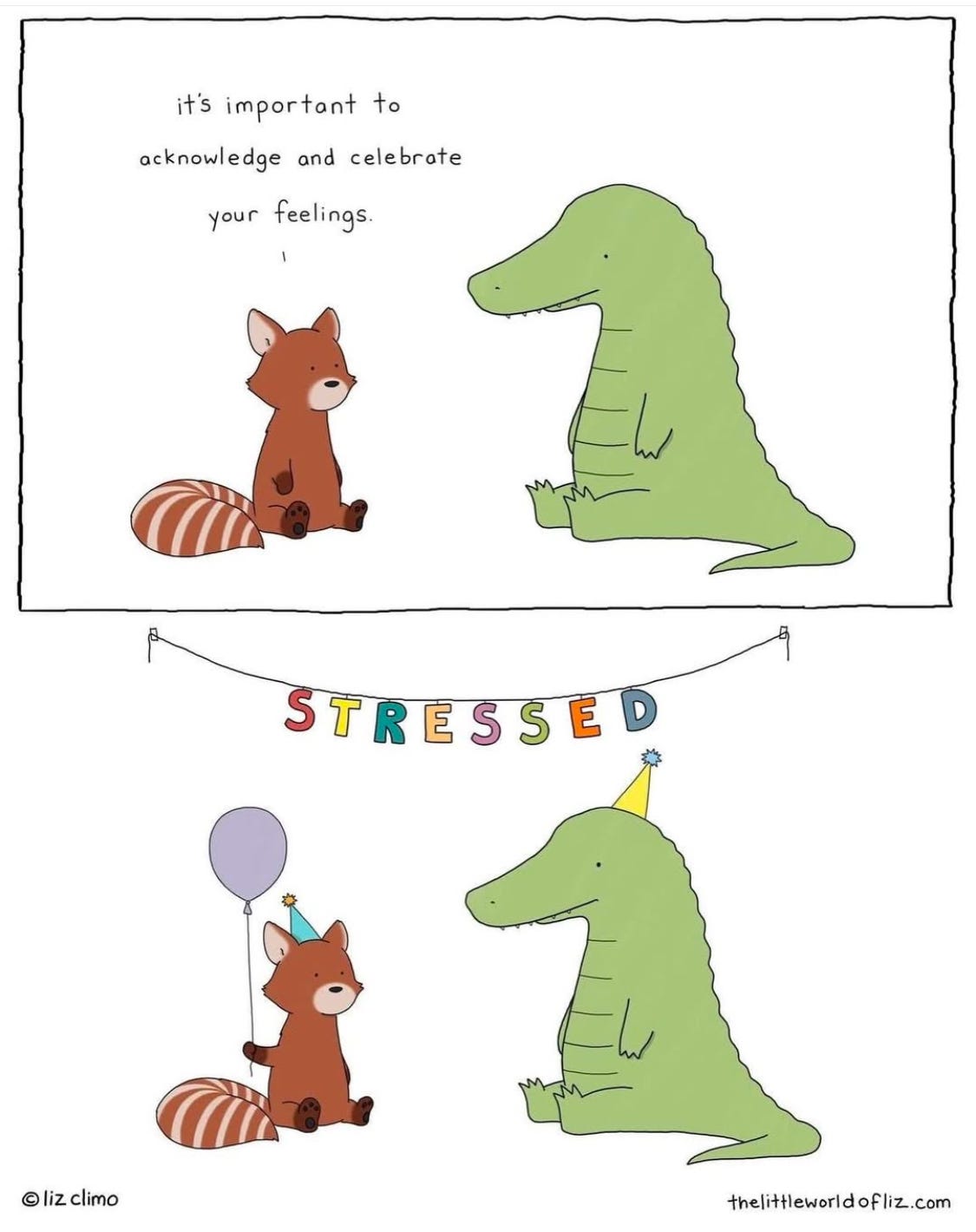
All unpleasant emotions are best dealt with by not avoiding them, but going through. Acknowledging and addressing. Don’t skip the acknowledgement piece. This is key to Emotional Intelligence and our own self-awareness †.
Now you know, though, that when you are going to address anxiety and its ilk, creativity and spontaneity are powerful friends.
ªChiu, F. et al. (2018). Effects of Creative Thinking and Its Personality Determinants on Negative Emotion Regulation. Psychological Reports, 122, 916 - 943. https://doi.org/10.1177/0033294118775973.
º (Quick note: I am pointing to the feelings of anxiety, not the debilitating mental-health disorder(s) connected to anxiety. If anxiety is crippling and limiting normal activity, mental health care should be pursued. Creativity and spontaneity would be a great supplement to treatment, but should not be the treatment.)
The information provided here is for educational purposes only and is not intended to replace professional mental-health advice, diagnosis, or treatment. Always seek the advice of your psychiatrist, therapist, or other qualified mental-health provider with any questions you may have regarding a psychological condition. If you are experiencing mental health symptoms, take care of yourself by contacting a psychiatrist, therapist, or other mental health professional.