
How we get Maslow wrong
We are not as far up the hierarchy as we think

High School Psychology 1:1 will almost certainly cover this foundational psychological theory: Maslow’s Hierarchy of Needs.
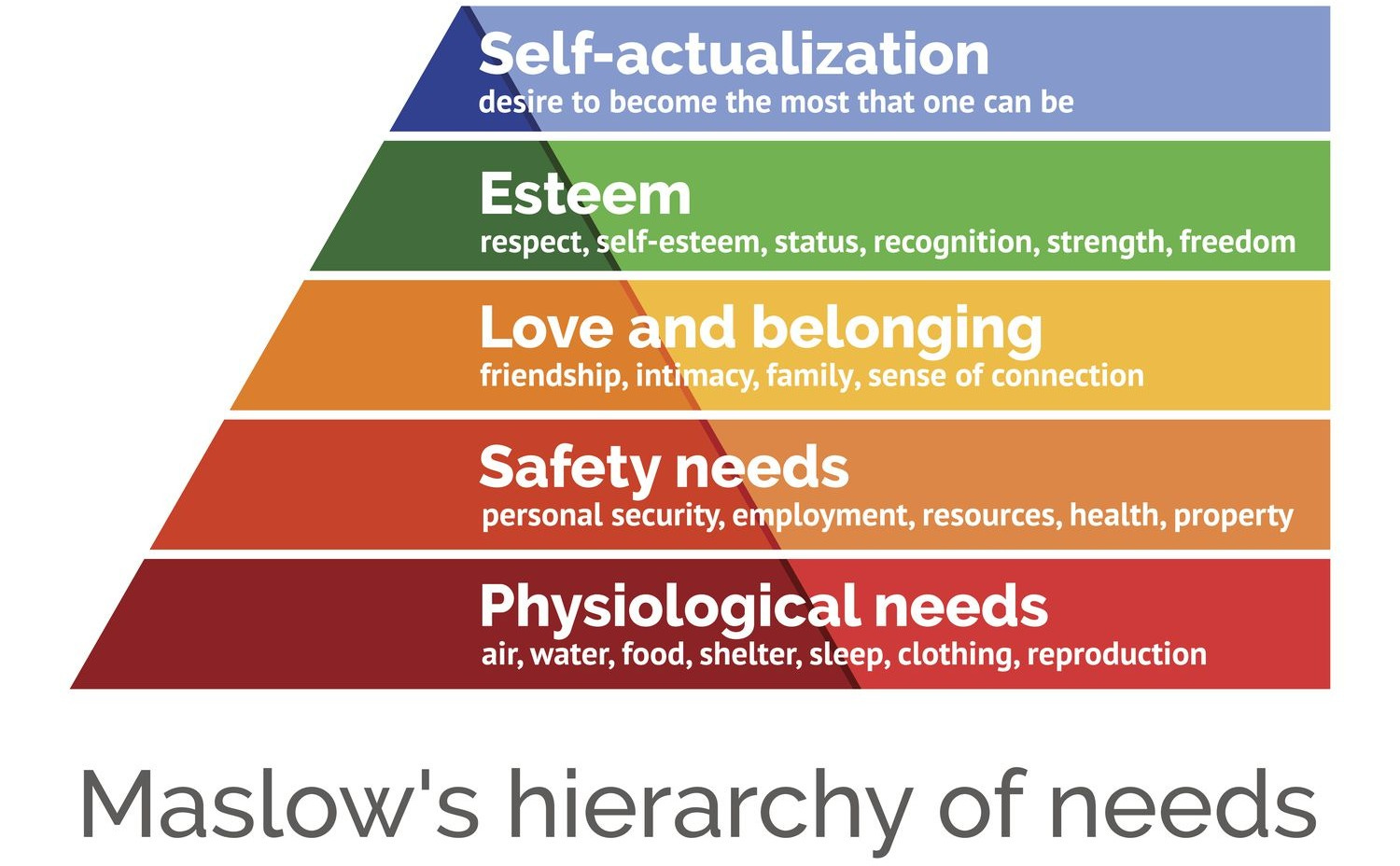
In the Western World, we often assume that most everyone we come in contact with at work, in therapy, in coaching has the base and next two or three levels of their pyramid squarely secured. On the surface, that is likely true, but the misconception exists because we stop at the surface and forget how humans are complex.
The problem is that though the physical and safety needs may be literally covered, at any point someone can feel unsafe and at risk, regardless of the logical reality of their situation. Our brains are very fast processors with ancient operating systems that connect patterns we aren’t consciously aware of. A thousand years ago, I was safe because I was with my tribe and not in the wilderness where the tiger was. Out in the wilderness means no safety and no sleep and no shelter and then death. The tribe helps me cover my physiological and safety needs, and ideally even more up and up the hierarchy, this is the ancient foundation of our safety as a species.
Enter social anxiety
Our ancient ancestors knew, and therefore our brain knows: “if I am rejected from my tribe, I will be exiled to the wilderness to be with the tiger, where I die.” In 2026, while not often at risk of death by tiger, I am at risk:
if I am fired from my job,
rejected from my tribe,
I will run out of money,
lose my shelter,
not be able to eat,
and thus, die.1
This can get even more twisted in our psyche, because with social safety nets I likely won’t die physically, but my entire sense of self will die—and for some, deep down, this is worse.
Our fast-processing connection-forming ancient brain therefore creates a fast-falling waterslide from the feelings of self-actualization and esteem down to the feeling of physiological threat (which elicits our physiological anxiety response). The reality of our situation has no impact on our feelings (6-figure net worth, emergency savings, a wealth of access to food and shelter, etc.).
We get Maslow wrong when we think people are operating from a place of self-actualization atop the pyramid, when actually a nasty email from their boss this morning has them operating like they are suffocating in the midst of a wildfire.
A feeling of threat at any level of the hierarchy can plunge us back down into our lizard brain response. When in a panic, try applying logic to those feelings and see what happens (good luck!). Situations can arise all day every day that send us down this waterslide in an instant. We can calm that nervous-system response, but completely preventing it is difficult.
If I am not loved, I will be out with the tiger—thus unsafe.
If I am not successful I won’t have enough resources to be safe.
If I don’t have a purpose then my place and legacy are unsafe.
All about safety
Our brains are wired to seek safety and a sense of control. Anything that looks or feels like a threat to our safety and control can activate responses that later might surprise ourselves. Interestingly, children/people who are Trauma survivors have been known to actually spark the abuse and thus increase the frequency of it in order to exert a sense of control over it, creating a tiny sliver of “safety” by reducing the lack of safety found in the uncertainty of when the abuse will happen.
The lack of safety that hijacks us is not simply the common risk of failure or disappointment, but it is the perceived threat to our livelihood, community, status, or finances if we mess up. We can’t eliminate all risk, but we can create clear guidelines that protect us from harm when we fail. Expressed clarity and support can work wonders for our sense of safety.
So what now?
We should be consistently gauging the feeling of safety.
Don’t assume people are operating anywhere above the safety line if you aren’t sure on how they are feeling.
Ask:
How safe does this feel? Where does it feel unsafe? What is causing that? Address anything quickly.
It might be simple:
-You might need a reminder of what is logically true.
-You might need reassurance that your respect, security, and role are not in question based on your performance in this task.
-You may just need to remind yourself of all your resources, all the people and places that could help you if you need it.
-Figure out what lack is challenging your safety and gently add it back.
I was awakened and inspired to this concept by Kristen Neff in her work Self-Compassion.