

Using Emotions in Decision-Making
it's already happening, just not intentionally or strategically

One of my favorite Emotional Intelligences questions and reflections is this:
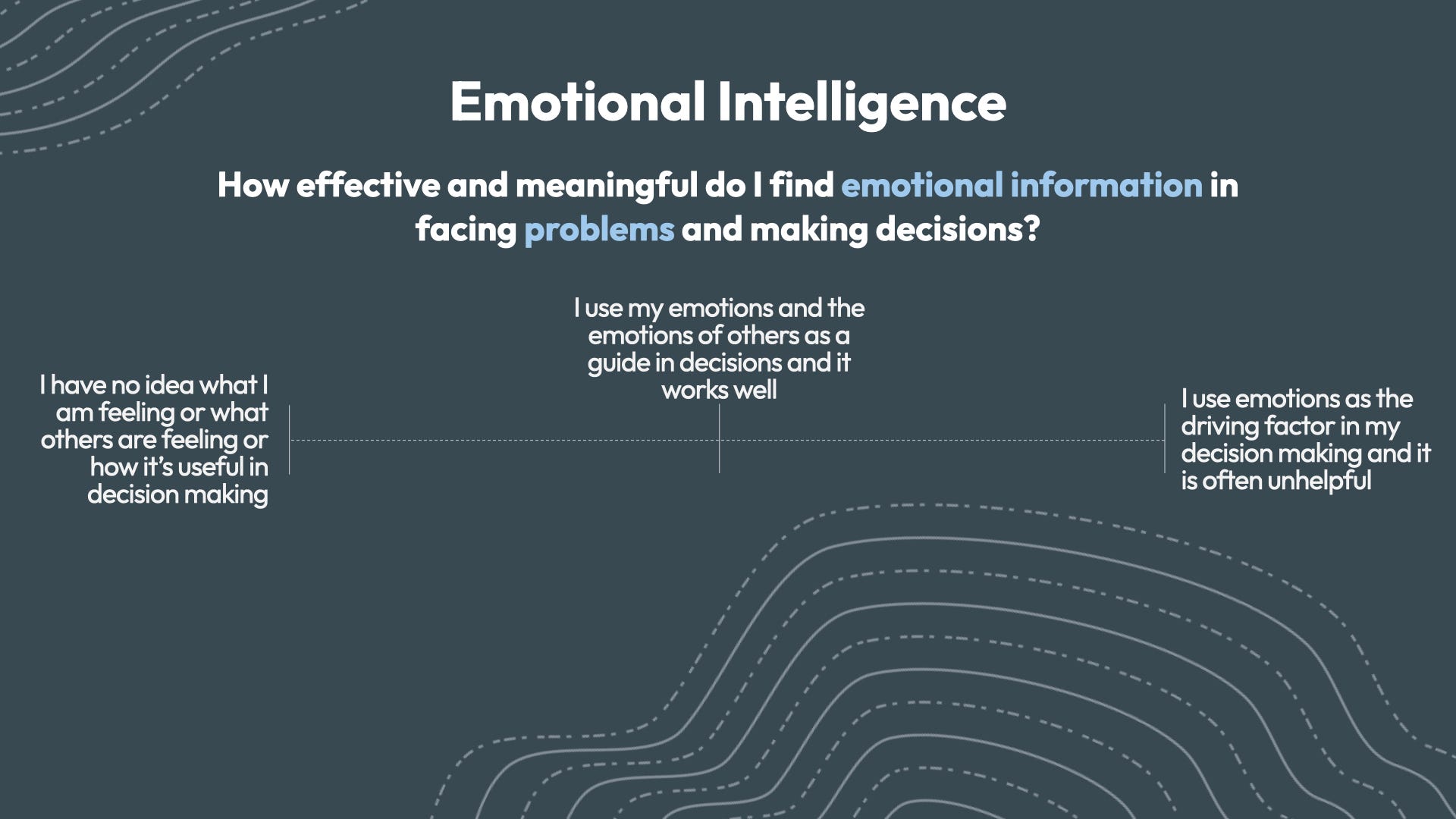
where do you plot yourself on this spectrum…
How effective and meaningful do I find emotional information in facing problems and making decisions?
I once had an Executive of a Financial Planning firm BOLDLY stand and tell his whole team that “emotions have NOTHING to do with decision making.” This is an interesting stance to take, since it is well documented market booms and sell-offs are emotions driven. Whether you want emotions to be involved in decision making is irrelevant, it IS part of the puzzle.
For example, at work we may feel exhausted from covering an absent position and anxious to get it filled, so we hire a less-than-ideal fit. Emotions impact our decisions.
Emotions affect impulse and impulse drives decisions. This is not always bad. Positive emotions our intuition
The key clarifier in using emotions in decision making is:
considering NO EMOTIONS in decision is equally bad and ineffective as
ONLY CONSIDERING emotions in decisions.
Our emotions are a dashboard light, and often our body and heart know something our mind does not see readily. This could be because of a lack of understanding, information, or context, it could be our brain inappropriately comparing a past story to a present one, and it could be because something is off and we haven’t found it yet. The important step is to pay attention. Consider emotions and let them serve as a guide. In the working West, emotions are being suppressed in decision-making, and better cultures would be created and better decisions would be made if the ever-present emotions were given room.
If the team feels good, should you ignore them?
I gave an off-the-cuff example in a workshop to bring this to a real leadership decision:
if your team has met a candidate and feels optimistic about them, is excited to work with them, is hopeful they’ll be on the team BUT
you (the hiring manager) are feeling skeptical about some experience missing from their resumé, making you feel uneasy about their day one competency… do you ignore the feelings of the team and hire the perfectly qualified person the team feels tense around?
Not an easy answer, eh?
There are tons of hiring guides, questions you can ask yourself and your team, ways to get insight from mentors, and a whole host of other ways to work through the tactical hiring pros and cons, but the emotions will have to be managed on the team either way. You hire the highly competent person the team is concerned about, now you likely have more unpleasant emotions to steward as the team wrestles with their disappointment, bewilderment, and even feelings of betrayal. You hire the person the team is excited about and the competence gaps never close, new unpleasant emotions arise from picking up the slack.
Sharing your emotions with the team and mining for more of their emotions is bound to create more insight.
They might offer to support training the person’s competency or point out transferable skills, or you might draw out positive feelings they have about the more competent candidate that they had not focused on before.
If you don’t ask any questions, ignore their feelings, and hire the competent person, maybe that person proves the team wrong over time, and you are able to fast-track relationship building between everyone. OR maybe the team’s vibe-check was accurate, and that person turns out to be what I affectionately call a brilliant jerk. A whole host of more problems and unpleasant emotions will follow. Likely including a high-performer’s resignation. Which causes more emotions and the cycle continues.
A decision must be made, so you can pay attention and steward the emotions before, during, and after the decision, or you can ignore them and try to sail through all the wake that follows. Hiring is risky. Decisions are risky. The reality is:
Considering emotions does not reduce risk, but it does increase information.
Emotionless Decisions make a hostile work environment
I have coached more people than I can count around navigating negative work environments that are often perpetuated by a lack of attention to the emotions being generated by decision-making. There will always be decisions that get made that cause unpleasant emotions to arise in someone, and your role as a leader and colleague is to steward those emotions and care for them. Not necessarily change the decision, but change how you deliver the news or how you support someone following it.
In the next 14 days, if you go from never considering emotions in any decision-making to considering emotions in two decisions, you have grown exponentially and that deserves celebration!
The Financial Exec I mentioned before? His major growth step at the end of our work together was simply stating to his team “Now I see emotions ARE important in decision making” and that makes all the difference.
Want to develop yourself or your team to make better decisions? I empower leaders to become more conscientious and effective through coaching and facilitated trainings.
Curious about work with me?